
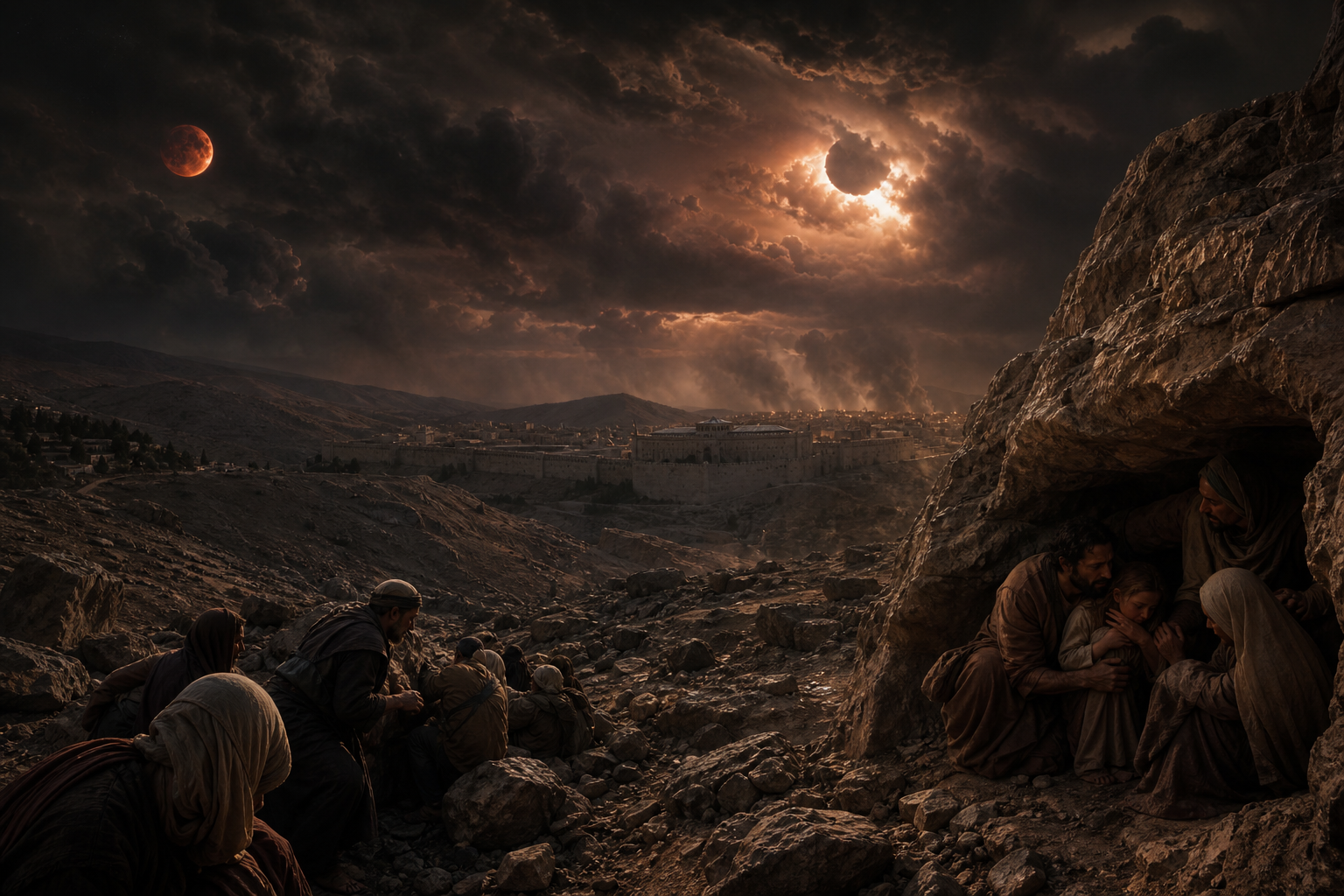
What happens when the sixth seal is opened? Revelation presents one of the most dramatic scenes in the Bible: the earth shakes, the sun becomes dark, the moon appears as blood, the stars fall, and the heavens seem to roll away. People from every level of society flee into caves and cry for the mountains to hide them.
Is this describing literal changes in the heavens, symbolic language for political collapse, or both? Does the sixth seal mark the end of the world, the beginning of God’s wrath, or a moment earlier in the prophetic sequence? The passage gives us a clear answer about its seriousness, while some details remain matters of interpretation.
The sixth seal in Revelation’s sequence
Revelation 5 shows the Lamb receiving the book sealed with seven seals. In Revelation 6, the Lamb opens the seals one by one. The first four reveal horsemen associated with conquest, conflict, famine, and death. The fifth seal shows faithful souls under the altar crying out for God to judge and avenge their blood, as described in Revelation 6:9–11.
The sixth seal follows that period of persecution and waiting. John writes, “And I beheld when he had opened the sixth seal, and, lo, there was a great earthquake” (Revelation 6:12). The sixth seal is not a small disturbance in human affairs. It affects the earth, the sky, the mountains, the islands, and the confidence of every class of society.
What John saw when the seal opened
Revelation 6:12 continues, “and the sun became black as sackcloth of hair, and the moon became as blood.” John then says, “And the stars of heaven fell unto the earth, even as a fig tree casteth her untimely figs, when she is shaken of a mighty wind” (Revelation 6:13).
Finally, John writes, “And the heaven departed as a scroll when it is rolled together; and every mountain and island were moved out of their places” (Revelation 6:14). The language is deliberately vast. The sixth seal reaches beyond one nation or one city. It describes creation itself being shaken before the presence and judgment of God.
The Bible uses similar language elsewhere when speaking about the day of the Lord. Joel 2:31 says, “The sun shall be turned into darkness, and the moon into blood, before the great and the terrible day of the LORD come.” Jesus also connects the darkening of the sun, the falling of the stars, and the shaking of the heavens with the end-time “coming of the Son of man” in Matthew 24:29–30.
These passages do not allow us to treat the sixth seal as an unrelated disaster. It belongs to the wider biblical pattern of creation being disturbed as God intervenes in judgment.
How do people respond?
Revelation does not portray humanity calmly studying the signs. It describes terror and helplessness. John writes, “And the kings of the earth, and the great men, and the rich men, and the chief captains, and the mighty men, and every bondman, and every free man, hid themselves in the dens and in the rocks of the mountains” (Revelation 6:15).
The list is important. Kings, military leaders, wealthy people, servants, and free people all respond in the same way. Social rank cannot protect anyone. Money cannot purchase safety. Military strength cannot resist the coming judgment. The sixth seal exposes the limits of human power.
The people then say to the mountains and rocks, “Fall on us, and hide us from the face of him that sitteth on the throne, and from the wrath of the Lamb” (Revelation 6:16).
This is one of Revelation’s striking expressions. The Lamb is the same one who was found worthy to open the book in Revelation 5. He is meek and sacrificial in His redemptive work, yet He is also the Judge before whom rebellious humanity must stand. Scripture does not present Jesus as only gentle in a way that excludes judgment. The One who gave Himself for sinners will also judge the world in righteousness.
The people understand what is happening. They do not merely say that a natural disaster has occurred. They recognize divine judgment. Revelation 6:17 records their question: “For the great day of his wrath is come; and who shall be able to stand?”
Literal event, symbolic picture, or both?
The main interpretive question concerns the form of these signs. Some readers understand the earthquake, darkened sun, bloodlike moon, falling stars, and moving mountains as literal cosmic events. Others emphasize the prophetic use of such language as a symbolic description of the collapse of rulers, nations, and established powers.
There is biblical support for taking the language seriously in both dimensions. Scripture sometimes uses heavenly signs to describe the fall of kingdoms. For example, Isaiah 13:10 speaks of the judgment of Babylon by saying, “For the stars of heaven and the constellations thereof shall not give their light: the sun shall be darkened in his going forth, and the moon shall not cause her light to shine.” In that passage, the imagery communicates the collapse of Babylon’s glory and security.
At the same time, Jesus speaks of the sun, moon, stars, and heavenly powers in connection with His future coming in Matthew 24:29. Revelation 6 may therefore describe real disturbances in the created order while using prophetic imagery that communicates their spiritual and political meaning. The text itself does not require us to reduce every sign to mere symbolism, nor does it give us permission to claim more physical details than Scripture provides.
A careful conclusion is this: the sixth seal describes a divinely caused shaking of the world, expressed through cosmic and earthly signs. Whether every feature occurs in precisely the physical manner some interpreters imagine is not stated in enough detail to settle dogmatically. The central truth is unmistakable: creation and human society are being brought face to face with the judgment of God.
Does the sixth seal happen before the wrath of God?
This question is closely connected with different views of end-time chronology. Some Christians place the sixth seal before the outpouring of later judgments and understand it as a sign that the great day of wrath is about to begin. Others see the seals themselves as part of the divine wrath already unfolding. Still others compare the sixth seal with the signs Jesus described before His visible return.
Revelation 6:17 plainly says that the day of the Lamb’s wrath “is come.” The verse does not say that humanity has merely received a warning about a distant possibility. The people recognize that the appointed time of judgment has arrived. Yet the verse does not by itself answer every question about the relationship between the sixth seal, the trumpet judgments, the bowls, the tribulation, or the gathering of the saints.
That limitation matters. Revelation should be read as Scripture, not as a chart onto which we force a complete timeline. The passage tells us what the sixth seal means more clearly than it tells us how every prophetic event must be arranged in relation to it.
Who can stand?
The final question of Revelation 6 is, “who shall be able to stand?” The immediate answer is not given until the next chapter. Revelation 7 begins with four angels holding back the winds, and it describes the sealing of the servants of God. John then sees a great multitude from all nations standing before the throne and before the Lamb, clothed in white robes.
Revelation 7:14 explains that these are those “which came out of great tribulation, and have washed their robes, and made them white in the blood of the Lamb.” The text therefore places the terror of Revelation 6 beside the preserving and redeeming work of God described in Revelation 7.
Christians differ about exactly where the sealing and the multitude fit in the end-time sequence. But the theological point is clear: human beings do not stand safely because of wealth, power, social position, or personal courage. Those who stand before God do so because they belong to Him and have been cleansed through the Lamb.
The plain answer
When the sixth seal is opened, God’s judgment is revealed through a world-shaking upheaval. The earth is shaken, the heavenly lights are darkened, the stars fall in John’s vision, and the heavens and earthly landmarks are moved. Every class of humanity recognizes that the day of divine wrath has arrived, and people try to hide from the One seated on the throne and from the wrath of the Lamb.
The passage does not give us a date. It does not identify a modern nation, leader, earthquake, eclipse, or military event as the sixth seal. It also does not authorize confident claims about a detailed prophetic timetable beyond what the text states. It calls us to believe that the Lord will judge the world, that Jesus Christ is the Lamb and Judge, and that no earthly refuge can replace reconciliation with God.
Why the sixth seal matters now
The sixth seal is not given merely to satisfy curiosity about frightening future events. It corrects the illusion that the present order will continue forever and that human beings can remain answerable only to themselves. The passage lifts our eyes from temporary security to the throne of God.
It also places urgency beside mercy. The people in Revelation 6 ask the mountains to hide them, but the gospel announces a better refuge before that day comes. Scripture calls people to turn to God, trust in Jesus Christ, and live faithfully rather than waiting until judgment is impossible to ignore.
The sixth seal warns that the world will one day be shaken. It also reminds us that the Lamb who judges is the One who gave Himself to save. The right response is neither sensational speculation nor careless indifference, but repentance, steadfast faith, and readiness for the appearing of Jesus Christ.
Continue the study
For more Scripture-first Bible explanations and cinematic studies, visit El Shaddai on YouTube.