
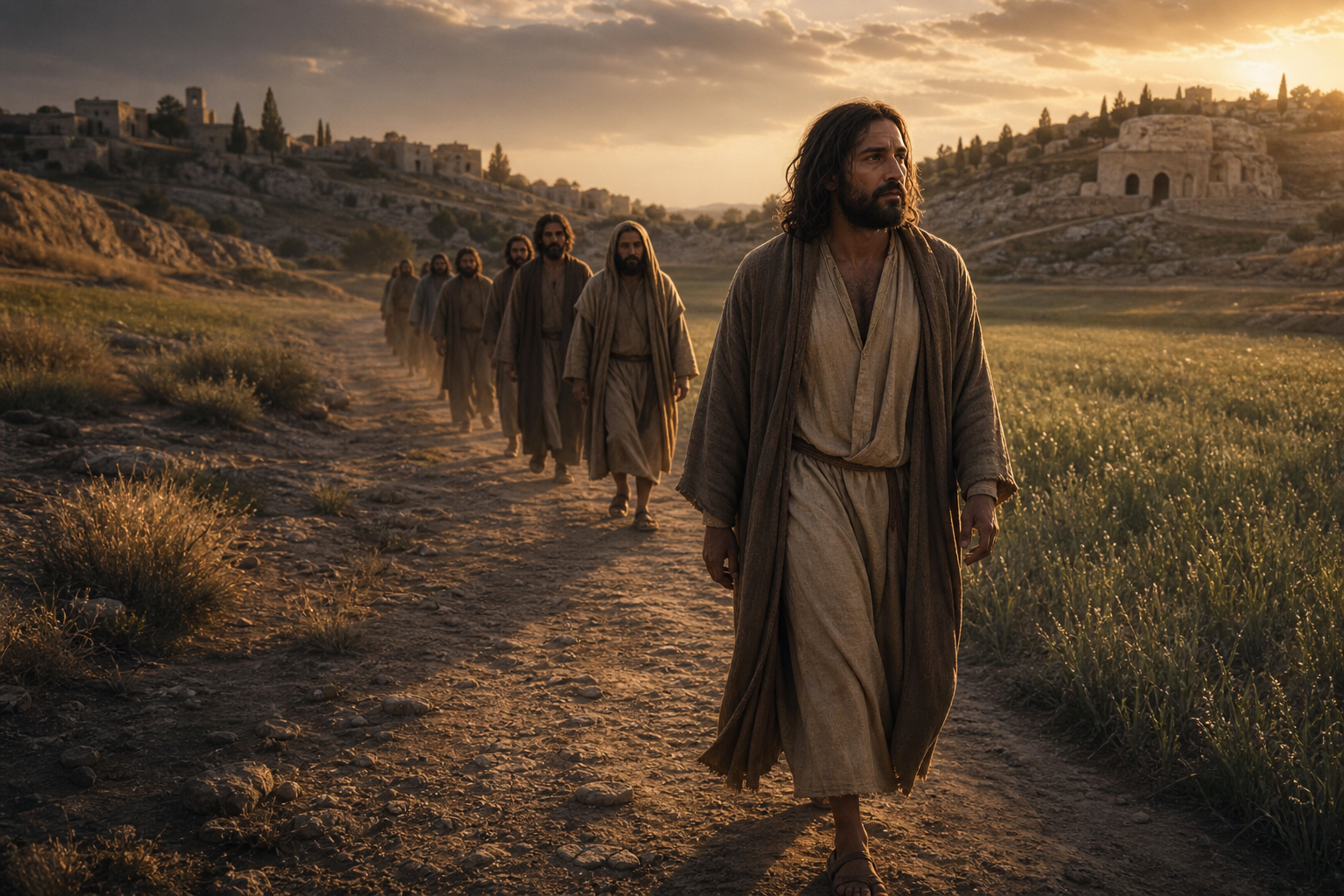
What did Jesus mean when He told a man, “Follow me; and let the dead bury their dead”? Was He forbidding a son from attending his father’s funeral? Was He rejecting family responsibility? Or was He exposing a deeper conflict between ordinary obligations and the urgent call of God?
The saying appears in two Gospel accounts. It is brief, severe, and easy to misunderstand when separated from its setting. Jesus was not making a general command for believers to ignore their parents or abandon compassion. He was confronting a man who wanted to follow Him, but who also wanted to delay that decision.
The saying in its Gospel setting
Matthew places the exchange among several encounters that reveal the cost of following Jesus. A scribe approached Him and said, “Master, I will follow thee whithersoever thou goest” (Matthew 8:19). Jesus answered, “The foxes have holes, and the birds of the air have nests; but the Son of man hath not where to lay his head” (Matthew 8:20).
Jesus’ answer appears to test whether the scribe understood what he was promising. Following Christ would not necessarily bring comfort, security, or social honor. The Son of man Himself lived without the ordinary shelter that animals possessed. His mission required complete trust in God.
Then another disciple spoke. Matthew 8:21 records his request: “Lord, suffer me first to go and bury my father.” Jesus replied, “Follow me; and let the dead bury their dead” (Matthew 8:22).
Luke gives the same encounter in a longer sequence. After another person says, “Lord, I will follow thee; but let me first go bid them farewell, which are at home at my house,” Jesus answers, “No man, having put his hand to the plough, and looking back, is fit for the kingdom of God” (Luke 9:61–62).
Luke also records Jesus telling another man, “Follow me” (Luke 9:59). That man answers, “Lord, suffer me first to go and bury my father.” Jesus responds, “Let the dead bury their dead: but go thou and preach the kingdom of God” (Luke 9:60).
Why the command sounds so shocking
In Scripture, caring for parents is not treated as a worthless duty. The law commanded, “Honour thy father and thy mother” (Exodus 20:12). Jesus rebuked religious traditions that allowed people to avoid supporting their parents while claiming that their resources were devoted to God. He said that such a person was violating the commandment of God by his tradition (Matthew 15:3–6).
Jesus also condemned religious hypocrisy, but He never taught cruelty as a virtue. While dying on the cross, He made provision for His mother by directing the beloved disciple to care for her. John 19:26–27 records that Jesus said to His mother, “Woman, behold thy son!” and then to the disciple, “Behold thy mother!” The passage says that from that hour the disciple took her into his own home.
These passages establish an important boundary. “Let the dead bury their dead” cannot mean that every act of family care is spiritually inferior or that believers may use religious zeal as an excuse for neglect. The difficult saying must be read alongside the whole witness of Scripture.
What does “the dead” mean?
The plainest explanation is that Jesus uses the word “dead” in two different senses in the same sentence. The first refers to those who are spiritually dead—people who are not responding to the call of God. The second refers to the man’s physically dead father, or to the ordinary burial responsibility associated with the family.
Jesus’ contrast would therefore mean: Let those who remain spiritually unresponsive handle the ordinary affairs of the dead; you have received a direct call to follow Me and proclaim the kingdom of God. This reading fits Luke 9:60, where Jesus adds, “but go thou and preach the kingdom of God.” The mission is not merely personal travel with Jesus. It is active participation in announcing God’s reign.
That interpretation is a reasonable inference from the wording and context. The text itself does not pause to define each use of “dead,” but the immediate command to preach the kingdom explains the urgency. Jesus is distinguishing between those who are spiritually alive to God’s call and those who remain outside that call.
Did the man’s father have to be buried immediately?
This question has led to more than one interpretation. Some readers understand the request literally: the man’s father had just died, and the son wanted to fulfill the funeral duty before becoming a disciple. If so, Jesus’ answer places the kingdom’s claim above even a solemn family obligation.
Other readers infer that the father may not yet have died. The man could have been saying, in effect, “I will follow You later, after my father’s life and burial are behind me.” On this reading, “bury my father” describes an indefinite delay rather than an immediate funeral. The passage itself does not tell us which situation was present, so it is wise not to present either possibility as certain.
Either way, the central issue is clear. The man says, “Let me first.” Jesus answers with “Follow me.” The conflict is not between Jesus and compassion. It is between an immediate divine summons and a condition that postpones obedience.
Jesus was claiming more than ordinary authority
The force of the saying becomes clearer when we notice who is speaking. Jesus does not merely offer advice about priorities. He calls the man to follow Him personally and to preach the kingdom of God. His authority reaches into the most serious decisions of human life.
Elsewhere, Jesus describes the cost of discipleship in equally direct terms. He says, “He that loveth father or mother more than me is not worthy of me” (Matthew 10:37). He does not command hatred of parents. In the same verse, He says, “he that loveth son or daughter more than me is not worthy of me.” The comparison concerns first loyalty. Even the closest human relationships must not displace allegiance to Christ.
Luke records a deliberately strong form of the same teaching. Jesus says that if anyone comes to Him and does not “hate” his father, mother, wife, children, brethren, sisters, and his own life also, he cannot be His disciple (Luke 14:26). This language is not permission to abuse or despise family. It is a forceful comparison: love for Christ must be so decisive that every other loyalty appears lesser by comparison.
Jesus Christ is the one true God manifest in the flesh, and His call is therefore not the call of one competing teacher among many. The Gospels present Him as possessing authority that demands the whole person. The command to follow Him is a command to place the kingdom of God above every rival claim.
What the saying does not mean
- It does not mean that parents are unimportant. Scripture commands honor toward parents, and Jesus opposed traditions that excused neglect.
- It does not mean that every funeral or family emergency must be ignored. The passage gives a particular command in a particular encounter, not a schedule for every disciple in every circumstance.
- It does not mean that ministry excuses disobedience to God’s moral commands. A person cannot claim to follow Jesus while practicing cruelty, dishonesty, or deliberate neglect.
- It does not mean that delayed obedience is always acceptable. Jesus exposes the danger of turning “later” into a permanent refusal.
We should also be careful not to use this passage to pressure people into reckless decisions. Jesus’ call is costly, but it is not manipulative. The text calls for wholehearted obedience, not for human leaders to place themselves above Scripture or above accountability.
The plough and the danger of looking back
Luke’s second account helps explain the first. One man says that he will follow Jesus, but first he wants to say farewell at home. Jesus replies, “No man, having put his hand to the plough, and looking back, is fit for the kingdom of God” (Luke 9:62).
The picture is simple. A farmer who continually looks behind him will not guide a straight furrow. The image does not say that a disciple may never remember family, grieve the past, or care for people at home. It warns against a divided commitment that begins forward but is governed by backward longing.
Jesus is not praising thoughtless impulsiveness. He is confronting excuses that sound reasonable but ultimately preserve control. “First let me…” can become a way to avoid the decisive step. The kingdom does not become less urgent because a delay has a respectable explanation.
A plain answer
Jesus meant that those who are spiritually dead could attend to the ordinary duties surrounding physical death, while the man who had heard Christ’s call was to respond immediately and proclaim the kingdom of God. Whether the father had already died or the request referred to a future burial is not settled by the text. What is settled is the priority Jesus demanded: no family duty, personal plan, or respectable delay may take the place of obedience to Him.
This does not cancel love for family. It orders love correctly. A disciple honors parents and serves others, but does not allow family expectations to veto the clear call of Christ. When duties genuinely conflict, the words of Jesus force the question: Which command has God actually given, and am I using a good responsibility to avoid a greater one?
Why this difficult saying matters
Jesus’ words matter because they reveal the difference between admiration and discipleship. Many people are willing to praise Jesus, agree with His teaching, or follow Him when the path is convenient. The man in this passage appears willing to follow, but he wants to place another matter first. Jesus brings the hidden condition into the open.
The passage also protects us from two opposite errors. We must not soften Jesus’ command until it costs nothing. Neither should we twist it into a license for coldness. The faithful response is to obey Christ completely while continuing to practice the love and responsibility Scripture commands.
“Let the dead bury their dead” is therefore not a celebration of neglect. It is a warning about divided allegiance. The kingdom of God is not one item to add after every other obligation has been satisfied. When Jesus says, “Follow me,” He calls for a response that is immediate, undivided, and shaped by His authority.
Continue the study
For more Scripture-first Bible explanations and cinematic studies, visit El Shaddai on YouTube.