
Who was Melchizedek—the mysterious king who appears for only a few verses in Genesis, yet becomes central to the book of Hebrews? Was he an angel, a pre-incarnate appearance of Christ, or simply a human king and priest? More importantly, why does the New Testament connect Jesus Christ with him?
The Bible gives us enough information to answer the main question, but it also leaves some details deliberately unexplained. A sound interpretation must therefore distinguish between what Scripture clearly states, what can reasonably be inferred, and what remains debated.
Melchizedek Appears Suddenly in Genesis
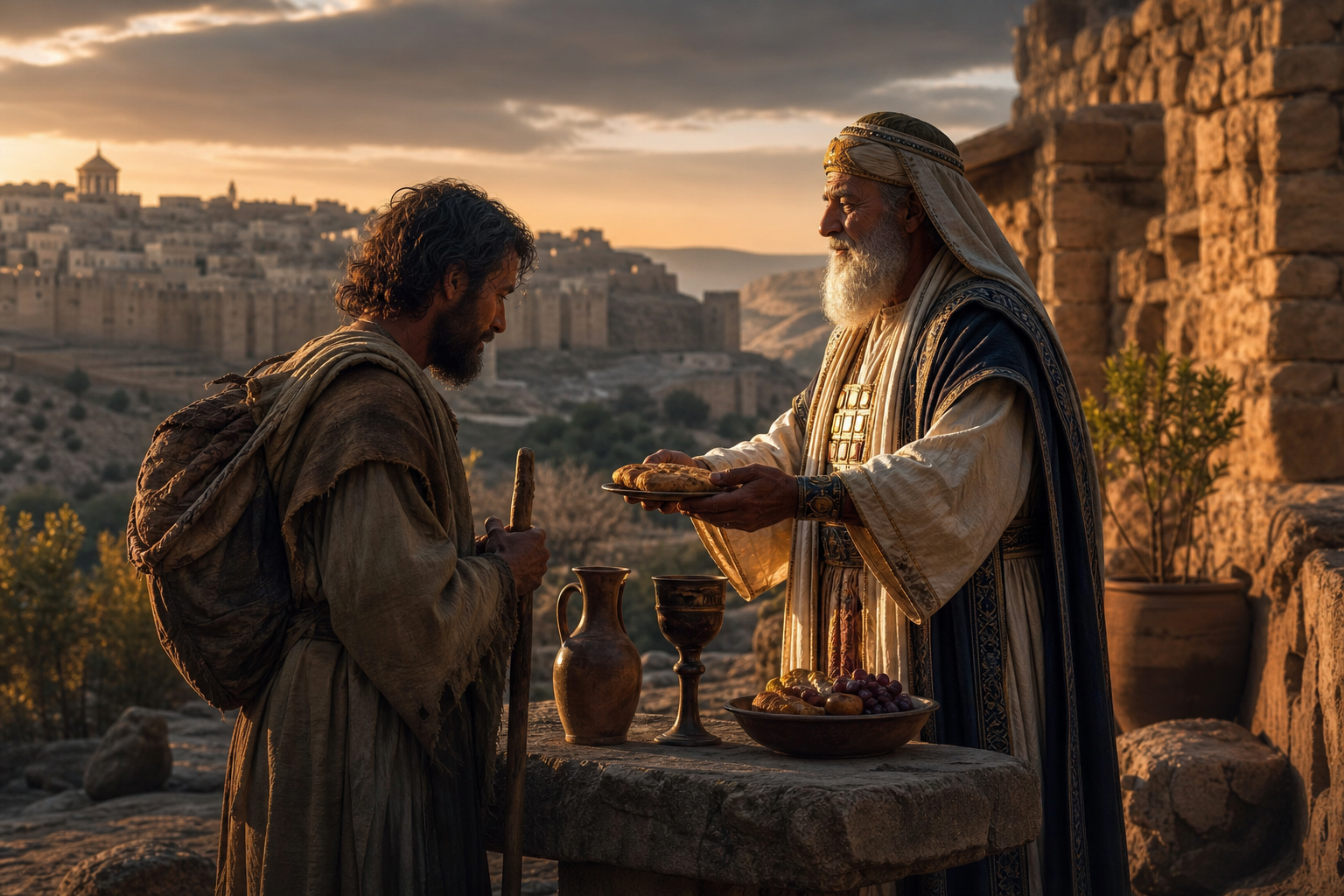
Melchizedek first appears after Abram—later called Abraham—rescued Lot and recovered the people and goods taken by invading kings. Genesis presents him without a genealogy or background story. His entrance is brief but significant.
“And Melchizedek king of Salem brought forth bread and wine: and he was the priest of the most high God. And he blessed him, and said, Blessed be Abram of the most high God, possessor of heaven and earth: And blessed be the most high God, which hath delivered thine enemies into thy hand. And he gave him tithes of all.” —Genesis 14:18–20
Several facts are plainly stated. Melchizedek was the king of Salem. He was also “the priest of the most high God.” He brought bread and wine, blessed Abram, praised God for giving Abram victory, and received a tenth of the recovered goods.
The passage does not describe Melchizedek as an Israelite. Abram had not yet become the father of the nation of Israel, and the Law of Moses had not yet been given. Nevertheless, Melchizedek already served as both king and priest, and he worshiped the true God.
What Does His Name and Title Tell Us?
The book of Hebrews explains the meaning associated with Melchizedek’s name and position. His name is understood as “King of righteousness,” and Salem is connected with peace. Hebrews uses these descriptions to show how Melchizedek provides a fitting pattern for Christ’s work.
“For this Melchisedec, king of Salem, priest of the most high God, who met Abraham returning from the slaughter of the kings, and blessed him; To whom also Abraham gave a tenth part of all; first being by interpretation King of righteousness, and after that also King of Salem, which is, King of peace.” —Hebrews 7:1–2
The text does not say that Melchizedek was the source of righteousness or peace. Rather, his title and office point forward to the greater King and Priest who would bring these realities in their fullest sense. Jesus is the true King of righteousness and the giver of peace with God.
Melchizedek’s blessing of Abram also shows his spiritual importance in the Genesis account. The greater blesses the lesser, and Abram responds by giving him tithes. The writer of Hebrews later uses this relationship as part of his argument for the superiority of Melchizedek’s priestly order over the Levitical priesthood.
Does “Without Father” Mean Melchizedek Was Not Human?
The most mysterious statement appears in Hebrews 7:3:
“Without father, without mother, without descent, having neither beginning of days, nor end of life; but made like unto the Son of God; abideth a priest continually.” —Hebrews 7:3
Read in isolation, this verse might seem to describe an eternal being who had no parents, no birth, and no death. Some interpreters have therefore identified Melchizedek as an appearance of Christ before His incarnation. Others have suggested that he was an angelic being.
However, the wording must be read in its context. Hebrews is explaining how Melchizedek functions in the biblical record. Genesis tells us nothing about his father, mother, ancestry, birth, or death. The point is not necessarily that Melchizedek literally had no parents or never died. The point is that Scripture records none of these details, making him a fitting picture of a priesthood that does not depend on a recorded genealogy.
This distinction matters. Hebrews does not say that Melchizedek was the Son of God. It says that he was “made like unto the Son of God.” The language of likeness presents him as a pattern or representation. The Son of God is the reality to which Melchizedek points.
It is possible that Melchizedek was more than an ordinary king, but Scripture does not require that conclusion. The clearest reading is that he was a real historical king and priest whose carefully limited appearance in Genesis became a prophetic pattern. The Bible does not give enough information to identify him with certainty as Christ Himself.
Psalm 110 Connects the Messiah to Melchizedek
Melchizedek’s importance does not rest only on Genesis. About a thousand years later, David recorded a promise concerning the coming Lord and King:
“The LORD hath sworn, and will not repent, Thou art a priest for ever after the order of Melchizedek.” —Psalm 110:4
This psalm joins kingship and priesthood in a way that was not permitted under the later Mosaic arrangement. Under the Law, the kings came from the tribe of Judah and the priests came from the tribe of Levi. Yet Psalm 110 foretold a ruler who would be both King and Priest—not according to the Levitical order, but according to the order of Melchizedek.
Jesus applied Psalm 110 to the Messiah when He questioned the scribes about David’s words. In Matthew 22:41–46, Jesus showed that the promised Christ was more than merely David’s human descendant. He is David’s Lord. The psalm therefore points beyond an ordinary earthly ruler to the exalted authority of Jesus Christ.
Hebrews Explains the Greater Priesthood
The book of Hebrews repeatedly uses Psalm 110 to explain Jesus’ priesthood. Jesus did not qualify as a priest through the family line of Aaron. His priesthood rests on God’s sworn promise and on the power of an endless life.
“So also Christ glorified not himself to be made an high priest; but he that said unto him, Thou art my Son, to day have I begotten thee. As he saith also in another place, Thou art a priest for ever after the order of Melchisedec.” —Hebrews 5:5–6
Jesus’ priesthood was not self-appointed. God appointed Him. The resurrection confirmed that death could not end His priestly ministry. Hebrews later states that Jesus is “made an high priest for ever after the order of Melchisedec” (Hebrews 6:20).
The contrast with the Levitical priesthood is central. The Levitical priests served because they belonged to a particular family, and their ministries ended when they died. Jesus, however, remains alive and continues His priestly work permanently.
“And they truly were many priests, because they were not suffered to continue by reason of death: But this man, because he continueth ever, hath an unchangeable priesthood.” —Hebrews 7:23–24
Jesus is not one priest among many who must be replaced. He is the one risen Lord whose priesthood cannot pass to another. As the one true God manifested in flesh, He made the sacrifice for sin and now stands as the permanent mediator of the new covenant.
Why Is Jesus’ Priesthood Better?
Hebrews gives several reasons. First, Jesus’ priesthood rests on God’s oath. Second, it is not dependent on ancestry. Third, it is permanent because Jesus lives forever. Fourth, Jesus offered Himself rather than repeatedly offering the blood of animals.
“For such an high priest became us, who is holy, harmless, undefiled, separate from sinners, and made higher than the heavens; Who needeth not daily, as those high priests, to offer up sacrifice, first for his own sins, and then for the people’s: for this he did once, when he offered up himself.” —Hebrews 7:26–27
Melchizedek brought bread and wine to Abram, but Genesis does not say that these items were a sacrifice for sin. The New Testament never instructs us to treat that scene as a direct account of the Lord’s Supper. The important connection is the priestly pattern: Melchizedek was king and priest, while Jesus fulfills both offices completely.
Jesus needed no sacrifice for His own sin because He was sinless. His one offering was sufficient. This is why the writer can say that Jesus “is able also to save them to the uttermost that come unto God by him, seeing he ever liveth to make intercession for them” (Hebrews 7:25).
What Can We Say with Confidence?
- Melchizedek was king of Salem and priest of the most high God. Genesis 14:18–20 plainly states this.
- He blessed Abram, and Abram gave him tithes. The passage presents Melchizedek as spiritually greater than Abram in that encounter.
- His recorded role points forward to Christ. Psalm 110 and Hebrews explicitly connect the Messiah with Melchizedek’s order.
- Scripture does not clearly identify Melchizedek as Christ Himself. Hebrews says he was made “like unto the Son of God,” which supports a typological reading.
- Jesus possesses the greater and everlasting priesthood. His authority comes from God’s promise, and His life cannot be ended by death.
Faithful readers may continue to disagree about whether Melchizedek was an ordinary human king, an extraordinary divine representative, or a pre-incarnate appearance of Christ. But that debate should not overshadow the point Hebrews makes. Melchizedek matters because his brief appearance establishes a biblical pattern that finds its fulfillment in Jesus.
Why This Mystery Matters
Melchizedek shows that God’s plan was larger than the later boundaries of the Levitical priesthood. Before Sinai, a king-priest worshiped the most high God. In David’s prophecy, God promised an everlasting priest-king. In Jesus Christ, that promise became reality.
The mystery also protects us from placing our confidence in temporary religious systems or human credentials. Jesus does not serve for a limited term, depend on a recorded family line, or need a successor. He died for our sins, rose again, and remains the living High Priest.
So who was Melchizedek? Scripture presents him as the king of Salem and priest of the most high God, a historical figure whose unexplained genealogy and combined office formed a powerful pattern. Why does he matter? Because the pattern directs our attention to Jesus Christ—the righteous King, the Prince of peace, and the everlasting Priest whose sacrifice is complete and whose ministry never ends.
Continue the study
For more Scripture-first Bible explanations and cinematic studies, visit El Shaddai on YouTube.