
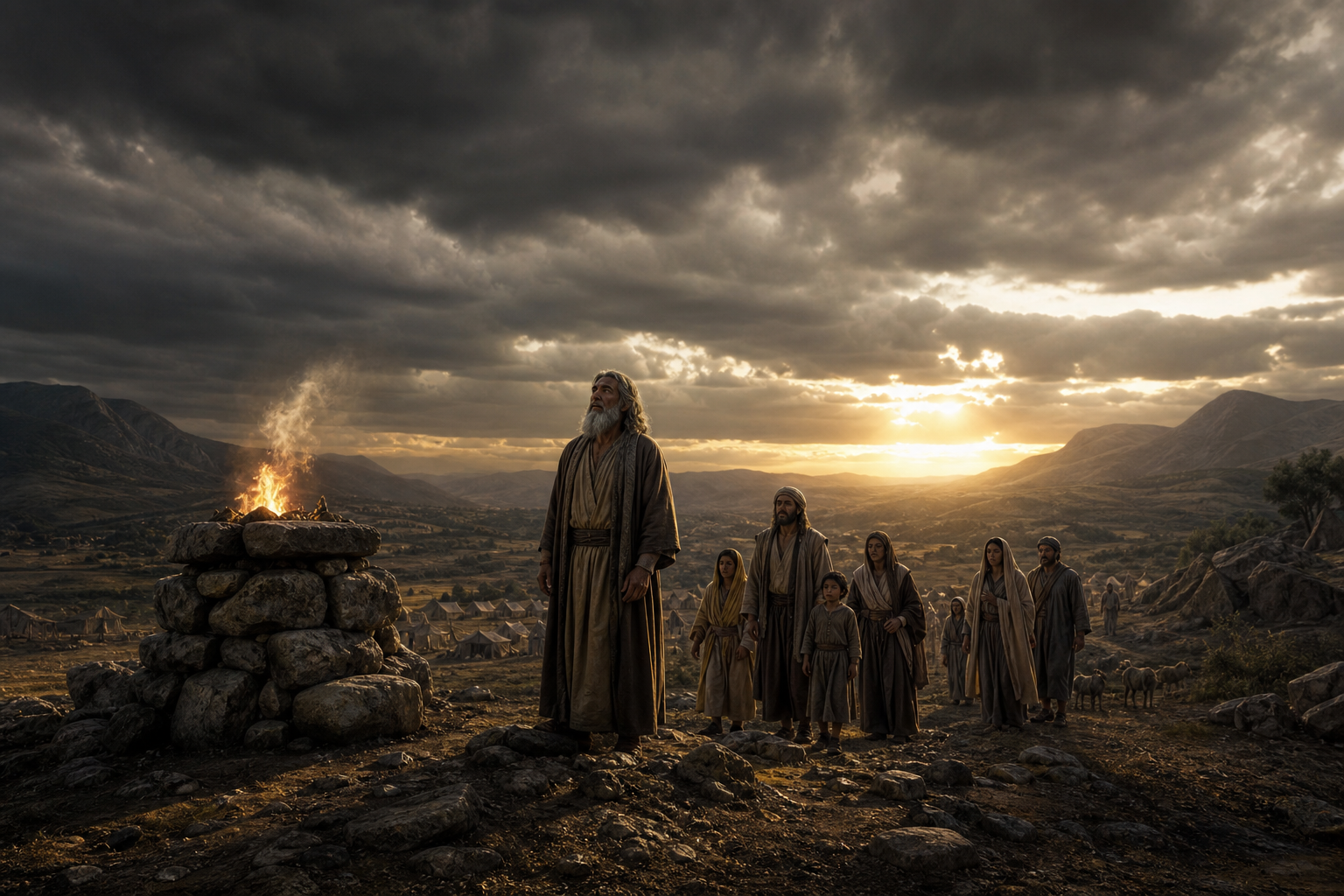
Who were the “sons of God” who took wives from the “daughters of men” before the flood? Genesis 6:1–4 is one of the Bible’s briefest and most mysterious passages. It has led some readers to believe that fallen angels married human women. Others understand the phrase as a description of men from the godly line of Seth marrying women from the rebellious line of Cain.
The passage is short, but its setting is important. Genesis has already shown sin spreading through the human family. Cain killed Abel in Genesis 4:8, and Cain’s descendants developed civilization while also displaying increasing violence. In Genesis 5, the family line of Seth is traced through men who called upon the name of the LORD and eventually leads to Noah. Genesis 6 then describes the moral collapse that brought judgment upon the earth.
What Genesis 6 actually says
Genesis 6:1–4 begins with the multiplication of humanity and the birth of daughters. Then Genesis 6:2 says, “That the sons of God saw the daughters of men that they were fair; and they took them wives of all which they chose.” The LORD responds to this corruption in Genesis 6:3 by saying, “My spirit shall not always strive with man, for that he also is flesh: yet his days shall be an hundred and twenty years.”
The passage then mentions giants. Genesis 6:4 says, “There were giants in the earth in those days; and also after that, when the sons of God came in unto the daughters of men, and they bare children to them, the same became mighty men which were of old, men of renown.”
Several observations are clear from the text:
- The events occurred during the generations before Noah’s flood.
- The sons of God saw, chose, and took wives.
- The LORD’s response centers on humanity, flesh, corruption, and coming judgment.
- The passage connects these marriages with people known as giants and mighty men of renown.
- Genesis does not directly identify the sons of God as angels, Sethites, kings, or any other specific group.
That last point matters. We must not make the passage say more than it says. At the same time, the phrase “sons of God” deserves careful comparison with other Scriptures.
The angelic interpretation
The most widely discussed alternative understands the sons of God as angels or heavenly beings. This view points especially to the book of Job. In Job 1:6, “the sons of God came to present themselves before the LORD,” and Satan came among them. Job 38:7 also speaks of “the sons of God” shouting for joy when God laid the foundation of the earth. In those passages, the expression appears to refer to heavenly beings rather than ordinary human men.
Supporters of the angelic interpretation also connect Genesis 6 with two New Testament passages. Jude 6 says, “And the angels which kept not their first estate, but left their own habitation, he hath reserved in everlasting chains under darkness unto the judgment of the great day.” Jude immediately describes certain sinners as having gone after “strange flesh” in Jude 7. Second Peter 2:4 likewise says, “For if God spared not the angels that sinned, but cast them down to hell, and delivered them into chains of darkness, to be reserved unto judgment.”
These passages clearly teach that some angels sinned and are under judgment. The question is whether Jude and Peter are specifically explaining Genesis 6. They do not mention Noah’s sons of God by name, and neither passage directly quotes Genesis 6. The connection is possible, but it remains an interpretation rather than an explicit statement.
There is also a serious difficulty with saying that angels married human beings. When Jesus answered the Sadducees about marriage after the resurrection, He said in Matthew 22:30, “For in the resurrection they neither marry, nor are given in marriage, but are as the angels of God in heaven.” Jesus’ words show that angels in heaven do not marry. Some argue that fallen angels could act differently from faithful angels, but that conclusion is not directly stated in Matthew 22:30.
Another difficulty is that Genesis 6 repeatedly describes the crisis in human terms. The LORD says in Genesis 6:3 that man is flesh. Genesis 6:5 says, “And GOD saw that the wickedness of man was great in the earth, and that every imagination of the thoughts of his heart was only evil continually.” The flood judgment is then directed against the violence and corruption of humanity. The angelic interpretation can account for the unusual language, but it must still explain why Genesis places such emphasis on human wickedness.
The Sethite interpretation
The traditional human interpretation identifies the sons of God with the godly line of Seth and the daughters of men with women from the ungodly line of Cain. Genesis 4 records Cain’s descendants, while Genesis 5 traces the line of Seth. This reading sees Genesis 6 as the collapse of a distinction that had been developing between those who called upon the LORD and those who lived in rebellion.
Genesis 4:26 says of Seth’s son, “Then began men to call upon the name of the LORD.” Genesis 5:29 also presents Noah as the one who would bring comfort from the curse upon the ground. In Genesis 6:9, Noah is described as “a just man and perfect in his generations, and Noah walked with God.” These details give the surrounding chapters a spiritual and moral contrast between obedience and rebellion.
On this understanding, “sons of God” is a description of men who belonged, at least by family identity, to the line associated with worship of the LORD. “Daughters of men” does not necessarily mean that every woman in the other group was personally wicked. Rather, the phrase can describe marriages formed according to human desire without regard for faithfulness to God. Genesis 6:2 emphasizes that the sons of God took wives because they saw that the women were fair and chose “of all which they chose.” The wording highlights uncontrolled desire and self-will.
This view fits the immediate story well. Human beings multiply, desire becomes dominant, violence fills the earth, and God judges the world with a flood. No supernatural offspring are required by the text. The “giants” of Genesis 6:4 can be understood as powerful or renowned men without requiring a theory about mixed angel-human biology. Scripture does not explain their height, origin, or physical nature in detail, so confident claims beyond the passage are unwarranted.
What about the phrase “sons of God”?
The phrase does sometimes refer to heavenly beings, especially in Job. That is why the angelic view cannot be dismissed as though it has no biblical basis. But words and phrases must be interpreted in their context. Scripture also uses family language for people who belong to God. Hosea 1:10 promises that the children of Israel “shall be called the sons of the living God,” and John 1:12 says that those who receive Christ and believe on His name receive power to become “the sons of God.”
Therefore, the phrase itself does not settle the question. The same expression can point to heavenly beings in one context and to God’s people in another. Genesis 6 must be read through its immediate setting, its human emphasis, and the broader teaching of Scripture.
Does Genesis 6 teach angel-human offspring?
The plain answer is that Genesis 6 does not explicitly teach that angels had sexual relations with human women. That interpretation is possible only by combining Genesis 6 with a particular reading of Job, Jude, and Second Peter. It is not a conclusion stated directly in Genesis.
The Sethite interpretation has a strong contextual case: it explains the contrast between the lines of Cain and Seth, preserves the human focus of the flood account, and agrees with the repeated biblical warning against choosing relationships without regard for God. It also avoids contradicting Jesus’ statement about angels and marriage.
Still, faithful readers should acknowledge that the passage has been interpreted differently. Jude 6 and Second Peter 2:4 plainly refer to angels who sinned, and some readers believe those verses preserve an apostolic interpretation of the events before the flood. The Bible does not give enough detail for us to reconstruct every part of that connection with certainty.
What can be stated confidently is this: Genesis 6 presents a world in which human desire, unchecked power, and spiritual rebellion had become pervasive. Whether the sons of God are understood as the godly line of Seth or as rebellious heavenly beings, the passage does not glorify the mysterious unions. It moves directly toward God’s grief over human wickedness and the judgment of the flood.
Why this mystery matters
The central warning of Genesis 6 is not the identity of the giants. It is the danger of a society that follows desire without submission to God. Genesis 6:5 says that the imagination of the human heart was continually evil, and Genesis 6:11 says, “The earth also was corrupt before God, and the earth was filled with violence.” The mystery appears within a larger account of moral collapse.
Jesus later compared the days before the flood with the time before His coming. In Matthew 24:37–39, He said that “as the days of Noe were, so shall also the coming of the Son of man be,” and that people were eating, drinking, marrying, and giving in marriage until the flood came. Jesus’ emphasis was not on identifying the sons of God. It was on people living as though ordinary life would continue forever while ignoring the warning of God.
Genesis 6 therefore calls us to read carefully and live soberly. We should distinguish what Scripture states from what interpreters infer. The text clearly teaches that God sees corruption, judges persistent wickedness, and preserves those who walk with Him. It leaves the exact identity of the sons of God less explicit than many explanations suggest. A careful reader can acknowledge the mystery without turning it into speculation—and can still hear the passage’s unmistakable call to faithfulness.
Continue the study
For more Scripture-first Bible explanations and cinematic studies, visit El Shaddai on YouTube.