
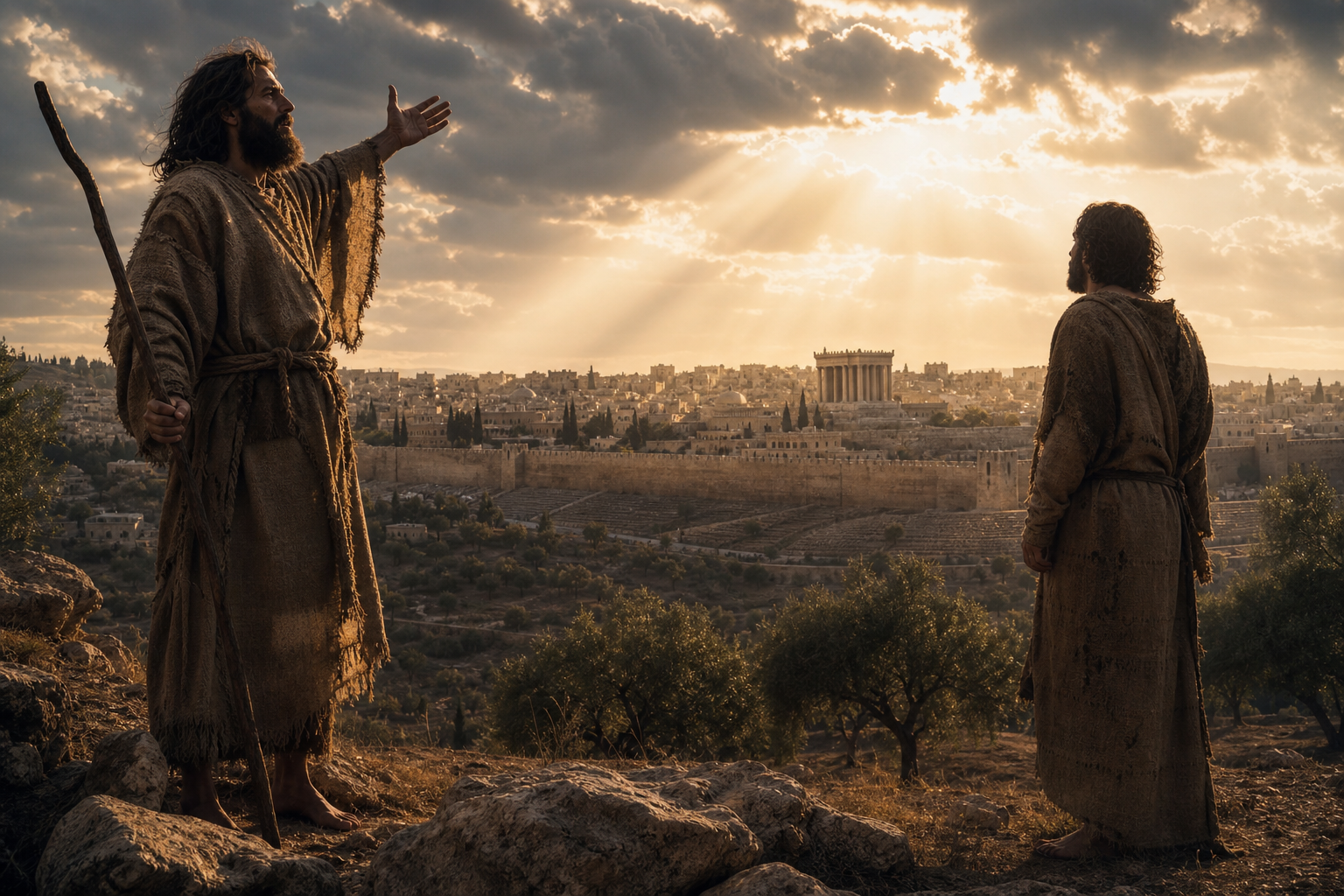
Are the two witnesses in Revelation on earth before the Rapture, or do they appear after the church is caught up? It is a direct question, but it cannot be answered responsibly by importing a complete end-times chart into a passage that does not provide one.
The two witnesses appear in Revelation 11. They prophesy for 1,260 days, exercise remarkable authority, are killed by the beast, lie unburied in Jerusalem, rise after three and a half days, and ascend into heaven while their enemies watch. The Rapture is described most directly in passages such as 1 Thessalonians 4:13–18 and 1 Corinthians 15:51–52. Those texts teach the catching away and transformation of believers, but they do not name the two witnesses.
So the plain biblical answer is this: Scripture does not explicitly state whether the two witnesses are before or after the Rapture. Their ministry belongs within the prophetic events surrounding the end, but the Bible does not give enough information to assign their ministry with certainty to one particular Rapture timeline. A pre-tribulation reading can place them after the church is caught away. Other readings can place their ministry before, during, or in relation to the same broad period without identifying a separate interval between the events.
What Revelation 11 actually says
John begins by describing a measuring of the temple, the altar, and those who worship there. He is told to leave the outer court to the Gentiles, “for it is given unto the Gentiles: and the holy city shall they tread under foot forty and two months” (Revelation 11:2). The passage then introduces the witnesses:
“And I will give power unto my two witnesses, and they shall prophesy a thousand two hundred and threescore days, clothed in sackcloth” (Revelation 11:3).
The text states that these witnesses are “the two olive trees, and the two candlesticks, standing before the God of the earth” (Revelation 11:4). This language recalls Zechariah 4, where two olive trees are associated with God’s work and the supply of oil for the lampstand. Revelation does not directly name the witnesses as Moses, Elijah, Enoch, or any other biblical figure. Identifying them with certainty goes beyond what the text says.
The witnesses receive authority to protect their testimony. Revelation 11:5 says, “And if any man will hurt them, fire proceedeth out of their mouth, and devoureth their enemies.” Revelation 11:6 adds that they have power to shut heaven so that it does not rain, to turn waters to blood, and to smite the earth with plagues. These signs resemble events associated with Elijah and Moses, which is why some interpreters identify the witnesses with those men. That resemblance is a reasonable observation, but it is not an explicit identification.
When their testimony is complete, the beast makes war against them:
“And when they shall have finished their testimony, the beast that ascendeth out of the bottomless pit shall make war against them, and shall overcome them, and kill them” (Revelation 11:7).
Their bodies remain in “the street of the great city, which spiritually is called Sodom and Egypt, where also our Lord was crucified” (Revelation 11:8). The reference to the place where the Lord was crucified points to Jerusalem, while the names Sodom and Egypt describe the city’s spiritual condition in that moment.
People from different nations see their dead bodies, refuse them burial, and celebrate their deaths. Revelation 11:11 then records the reversal:
“And after three days and an half the Spirit of life from God entered into them, and they stood upon their feet; and great fear fell upon them which saw them” (Revelation 11:11).
They hear a voice from heaven saying, “Come up hither.” They ascend in a cloud, and their enemies see them (Revelation 11:12). A great earthquake follows, and the survivors give glory to the God of heaven (Revelation 11:13). The second woe then passes, and the seventh angel sounds his trumpet (Revelation 11:14–15).
What the Bible says about the Rapture
The word “Rapture” does not appear in the King James Bible, but the event commonly called the Rapture is clearly described. Paul tells believers not to sorrow as those who have no hope, because Jesus died and rose again and God will bring with Him those who sleep in Jesus (1 Thessalonians 4:13–14).
He then describes the Lord’s descent and the gathering of His people:
“For the Lord himself shall descend from heaven with a shout, with the voice of the archangel, and with the trump of God: and the dead in Christ shall rise first” (1 Thessalonians 4:16).
Paul continues, “Then we which are alive and remain shall be caught up together with them in the clouds, to meet the Lord in the air” (1 Thessalonians 4:17). This passage plainly teaches a resurrection of dead believers and a catching up of living believers to meet the Lord. It does not mention the two witnesses, the beast, Jerusalem, or the length of the witnesses’ ministry.
First Corinthians 15 gives another important detail. Paul says, “Behold, I shew you a mystery; We shall not all sleep, but we shall all be changed” (1 Corinthians 15:51). He says this change occurs “in a moment, in the twinkling of an eye, at the last trump” (1 Corinthians 15:52). The dead are raised incorruptible, and living believers are changed.
Because Revelation 11 mentions a seventh trumpet and 1 Corinthians 15 mentions “the last trump,” some readers equate the two. Others understand the trumpets in the two passages as different references because the surrounding contexts are different. The Bible does not directly say, “The seventh trumpet of Revelation is the last trump of 1 Corinthians 15.” That connection may be argued, but it should not be presented as an unqualified statement.
Why many pre-tribulation readers place the witnesses after the Rapture
In a pre-tribulation understanding, the church is caught up before a future period of intense judgment and persecution. Since the two witnesses minister during the prophetic period described in Revelation 11, this view commonly places their ministry after the Rapture.
This interpretation also observes that the witnesses have a public ministry in Jerusalem during a time when the beast is active and the holy city is being trodden down. If the Rapture has already gathered the church, God could raise up these witnesses as a distinct testimony to Israel and the nations during that period.
That is a coherent prophetic framework, but Revelation 11 itself never says, “The church has already been raptured.” Nor does 1 Thessalonians 4 say that the catching away occurs before the witnesses begin their testimony. The conclusion depends on how a reader arranges several passages, not on a direct chronological statement.
Why other readers do not place the witnesses strictly after the Rapture
Readers who reject a pre-tribulation timeline may understand the church as remaining on earth through some or all of the tribulation, while still expecting Christ to gather His people. From that perspective, the two witnesses could minister before the gathering, during the same general period, or near the end of the prophetic conflict.
Jesus spoke of His coming and the gathering of the elect in Matthew 24. After describing tribulation and cosmic signs, He said, “And he shall send his angels with a great sound of a trumpet, and they shall gather together his elect from the four winds” (Matthew 24:31). Many readers connect this gathering with the Rapture. Others distinguish this gathering from the event described in 1 Thessalonians 4. The passage must therefore be considered carefully rather than used as a shortcut to settle every chronological question.
Jesus also said, “But of that day and hour knoweth no man, no, not the angels of heaven, but my Father only” (Matthew 24:36). Whatever position a reader takes on the order of prophetic events, this warning rules out date-setting and calls for humility about details Scripture has not plainly arranged.
What can be said with confidence?
- The two witnesses are real figures in John’s prophetic vision. Revelation presents them as appointed servants who give a public testimony.
- Their ministry lasts 1,260 days. This duration is stated in Revelation 11:3.
- The beast kills them only after they finish their testimony. Revelation 11:7 emphasizes that their death does not occur by accident or before God’s appointed work is complete.
- God raises them from the dead. Their resurrection and ascension are central features of Revelation 11:11–12.
- The Rapture is a biblical hope. First Thessalonians 4:16–17 and 1 Corinthians 15:51–52 describe the resurrection and transformation of believers.
- The Bible does not directly state the relationship between the two events. No verse says that the witnesses begin their ministry a certain number of days before or after the church is caught up.
A plain answer to the question
If the question means, “Does the Bible clearly tell us whether the two witnesses are before or after the Rapture?” the answer is no. The text gives the witnesses’ ministry, death, resurrection, and ascension. It gives the promise that believers will be caught up to meet the Lord. It does not explicitly join those descriptions into a complete sequence.
If someone adopts a pre-tribulation view, it is reasonable within that system to place the witnesses after the Rapture. But that is an inference from the larger prophetic framework, not a sentence directly found in Revelation 11. A reader who believes the church passes through tribulation may reach a different conclusion while still affirming the authority of the same passages.
The safest approach is to hold firmly to what Scripture states and carefully label what is inferred. We can proclaim the coming of Jesus Christ, the resurrection of the dead in Christ, the transformation of living believers, the faithfulness of God’s witnesses, and the certainty of final judgment without pretending to know an order that the Bible leaves unstated.
Why the passage matters
Revelation 11 is not merely a puzzle piece for an end-times diagram. It shows that God’s testimony cannot be silenced before its appointed work is finished. The witnesses are opposed, publicly shamed, and killed, yet their apparent defeat is followed by resurrection and ascension. Their story points to the larger biblical pattern in which death does not have the final word.
The passage also directs attention to Jesus Christ. The Lord who will gather His people is the same Lord whose authority stands behind every true witness. Revelation calls readers to faithfulness, watchfulness, and reverence—not to confident predictions about dates or details God has not disclosed. As Jesus said, “Be ye also ready: for in such an hour as ye think not the Son of man cometh” (Matthew 24:44).
Whether the two witnesses are understood as preceding the Rapture, following it, or ministering within a timeline that faithful readers continue to debate, the central message remains clear: God keeps His word, Christ will come, His people will be raised and changed, and no enemy can finally overcome the testimony God has appointed.
Continue the study
For more Scripture-first Bible explanations and cinematic studies, visit El Shaddai on YouTube.