
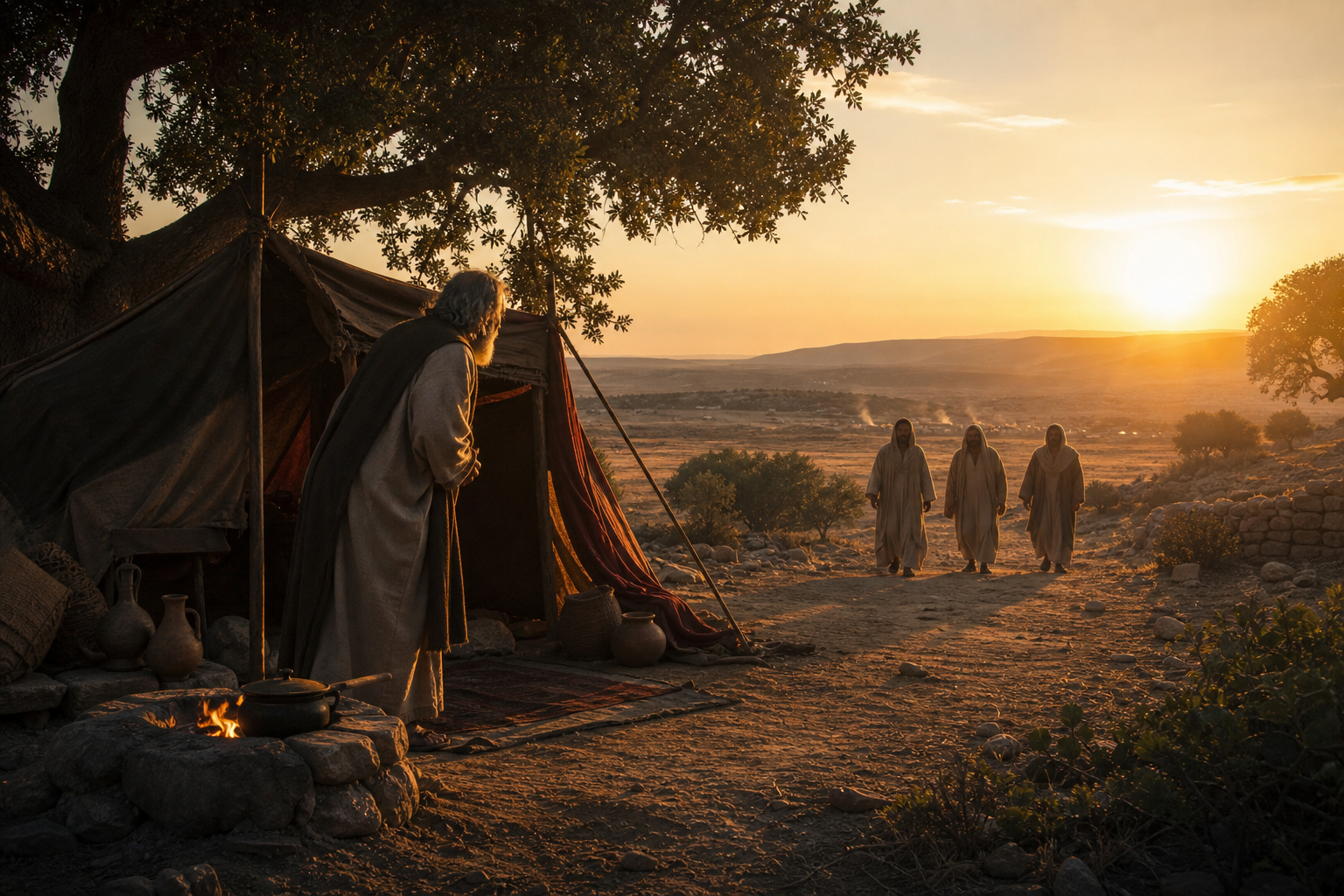
Why did angels visit Abraham before Sodom was destroyed? Genesis 18 gives us one of the Bible’s most striking scenes: Abraham sees three men approaching, welcomes them to his tent, and then speaks with the LORD about the fate of Sodom. In the next chapter, two angels arrive in Sodom. Who were these visitors, and why did God come to Abraham before judgment fell?
The passage is not merely an unusual travel story. It connects God’s covenant promise to Abraham with the exposure of Sodom’s wickedness, Abraham’s intercession, and the rescue of Lot. The text also raises a question about how the invisible God made Himself known in visible form.
What Genesis 18 actually says
Genesis begins by identifying the central event plainly: “And the LORD appeared unto him in the plains of Mamre” (Genesis 18:1). The next verse describes what Abraham saw: “And he lift up his eyes and looked, and, lo, three men stood by him” (Genesis 18:2).
Abraham immediately acts with hospitality. He bows, offers water, rest, and food, and asks the visitors not to pass by. The account then describes a meal of bread, butter, milk, and a calf that Abraham prepares. The visitors are presented in ordinary human form, yet the narrative makes clear that this is more than an ordinary visit.
One of the visitors announces that Sarah will have a son. When Sarah laughs within herself at the promise, the speaker asks, “Why did Sarah laugh?” (Genesis 18:13). He then repeats the promise and declares, “Is any thing too hard for the LORD?” (Genesis 18:14).
The identity of the speaker is especially important. Genesis does not say that Abraham was speaking to three separate divine beings. Rather, the chapter distinguishes the LORD from the two other visitors as the story unfolds. Genesis 18:16 says, “And the men rose up from thence, and looked toward Sodom.” Then Genesis 18:22 adds, “And the men turned their faces from thence, and went toward Sodom: but Abraham stood yet before the LORD.”
The simplest reading of the narrative is that three visitors came to Abraham, while the LORD was personally present among them. Two continued toward Sodom, and Abraham remained before the LORD. Genesis 19:1 identifies the two who entered Sodom: “And there came two angels to Sodom at even.”
Why did God come before judgment?
The visit serves several purposes at once. First, it confirms God’s promise to Abraham and Sarah. The Lord did not appear to Abraham only to announce destruction. He came in the setting of covenant promise. The birth of Isaac would show that God’s word was dependable even when the promise seemed humanly impossible.
Second, God came to reveal what was about to happen to Sodom. The LORD says, “Because the cry of Sodom and Gomorrha is great, and because their sin is very grievous” (Genesis 18:20). He then says, “I will go down now, and see whether they have done altogether according to the cry of it” (Genesis 18:21).
This language should not be understood as though God lacks knowledge and must gather information. Scripture often describes God’s action in ways people can understand. The passage shows that judgment is not random or careless. God presents the case, acknowledges the grave accusation, and proceeds with moral clarity.
Third, the visit creates the setting for Abraham’s intercession. Abraham asks whether the righteous will be destroyed with the wicked and appeals to God’s justice: “Shall not the Judge of all the earth do right?” (Genesis 18:25). He then asks whether Sodom might be spared for the sake of fifty righteous people, and continues down to ten.
God agrees that He would spare the city for the sake of ten righteous people, as recorded in Genesis 18:32. The passage does not say that Abraham’s prayer changed God from unjust to merciful. Instead, it reveals the justice and mercy already belonging to the Judge of all the earth. Abraham is permitted to bring his concern openly before God.
Were all three visitors angels?
The text calls the visitors “men” in Genesis 18 and later calls two of them “angels” in Genesis 19:1. For that reason, it is reasonable to understand the two who went to Sodom as heavenly messengers appearing in human form. Hebrews also uses Abraham’s experience when it says, “Be not forgetful to entertain strangers: for thereby some have entertained angels unawares” (Hebrews 13:2).
However, Genesis does not call all three visitors angels in Genesis 18. It identifies the LORD as appearing to Abraham and then distinguishes Him from the two men who go toward Sodom. A careful explanation should therefore avoid saying that three ordinary angels visited Abraham, or that the passage presents three divine persons.
The biblical text presents one LORD and two angelic messengers. The LORD made Himself known in visible form, while the two messengers carried out the work connected with Sodom. Scripture does not require us to imagine God the Father as a separate human figure standing beside two other divine persons. The one true God was present and revealed Himself as He chose.
Some Christians understand the LORD’s visible appearance here as a manifestation of Christ before His birth at Bethlehem. That interpretation can be held within a Christian reading of the whole Bible, especially since Jesus Christ is the one true God manifest in the flesh. Yet Genesis 18 itself does not use the name Jesus or explain the appearance in those later New Testament terms. The safest conclusion from the immediate passage is that the LORD appeared to Abraham, accompanied by two heavenly messengers.
Why were the two angels sent to Sodom?
The two angels had a specific mission. They entered Sodom, warned Lot, and urged him to bring his household out of the city. Genesis 19:12 records their question: “Hast thou here any besides? son in law, and thy sons, and thy daughters, and whatsoever thou hast in the city, bring them out of this place.”
Their visit also exposed the depth of Sodom’s corruption. The men of the city surrounded Lot’s house and demanded access to the visitors. The account shows that the judgment was not based on a vague reputation or a single isolated incident. The violence and depravity of the city confirmed the seriousness of the cry that had come before God.
At the same time, the angels did not treat Lot’s rescue as a reward for perfect faithfulness. Lot hesitated, and the messengers seized his hand, along with the hands of his wife and daughters, because “the LORD being merciful unto him” (Genesis 19:16). The passage joins human weakness with divine mercy without excusing the wickedness of Sodom.
One detail also links Genesis 18 and Genesis 19. Abraham had pleaded for the righteous to be spared, and Genesis 19:29 says, “God remembered Abraham, and sent Lot out of the midst of the overthrow.” The text does not say that Lot was the ten righteous people Abraham had hoped to find. It does show that Abraham’s relationship with God and his prayer belong to the larger story of Lot’s deliverance.
What does Abraham’s hospitality teach?
Abraham did not know at first that his guests were heavenly visitors. He saw men by the tent and responded with generous hospitality. Hebrews 13:2 draws a practical lesson from this fact: people may receive God’s messengers without recognizing who they are.
This does not mean that every stranger carries a hidden supernatural identity. The passage does not invite gullibility or abandon wisdom. It teaches that faithful people should not become so self-protective or self-absorbed that they refuse ordinary opportunities to show kindness.
Abraham’s hospitality also shows that service can become the setting in which God gives understanding. He offered food and rest before he received the announcement about Isaac or heard the news about Sodom. The story moves from a meal at the tent to a serious conversation about promise, judgment, and mercy.
The main interpretive issue
The difficult question is not whether angels exist. Scripture clearly teaches that God sends angels as messengers and servants. The harder issue is the relationship between the three visitors in Genesis 18.
- What the text states: The LORD appeared to Abraham; three men came; the LORD spoke; two visitors went toward Sodom; and Genesis 19 calls those two visitors angels.
- What is a reasonable inference: The two men who went to Sodom were the two angels later mentioned in Genesis 19, while the third visitor was the LORD.
- What remains debated: Some readers identify the LORD’s appearance as a pre-incarnate appearance of Christ. Others simply describe it as a visible manifestation of the LORD without assigning it a later New Testament title.
The passage should not be used to construct a doctrine of three gods or three separate divine persons. Its emphasis is the opposite: the one LORD speaks, judges, promises, and shows mercy. The two angels are servants sent to accomplish His purpose.
A plain answer
Angels visited Abraham before Sodom because God was about to fulfill His promise, reveal the grounds of Sodom’s judgment, receive Abraham’s intercession, and send messengers to rescue Lot. The two angels were part of a larger divine visitation in which the LORD appeared to Abraham.
God’s order is significant. Before judgment came, He gave Abraham understanding. Before Sodom fell, Lot was warned. Before the destruction, mercy made a way of escape. The story does not portray judgment as impulsive or hidden. It shows a righteous God who knows the truth, hears intercession, and distinguishes between the wicked and those He is willing to deliver.
Why this mysterious visit matters
Genesis 18–19 holds together truths that people often separate. God is merciful, but He is not indifferent to evil. He judges, but He does not act unjustly. He sends heavenly messengers, yet He personally makes His will known. He hears Abraham’s questions without surrendering His authority.
The passage also calls readers to take both hospitality and holiness seriously. Abraham welcomed strangers. Abraham prayed for others. Lot was warned to leave a corrupt environment rather than remain attached to it. And the LORD showed that rescue is grounded in His mercy.
The mystery of the visitors therefore points beyond curiosity about angels. It reveals the character of the God who appeared to Abraham: faithful to His promise, righteous in judgment, open to intercession, and merciful toward those He brings out of danger.
Continue the study
For more Scripture-first Bible explanations and cinematic studies, visit El Shaddai on YouTube.