
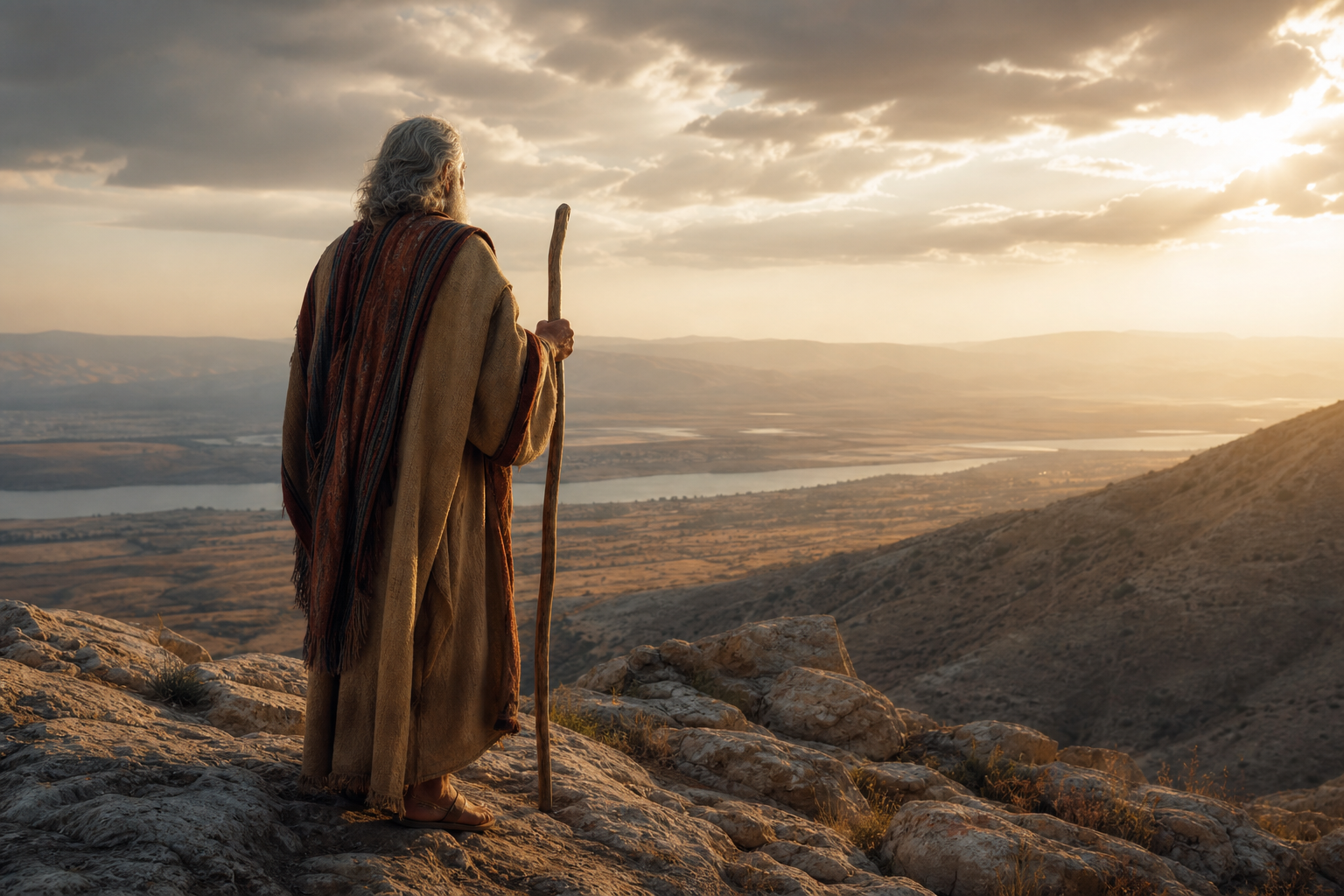
The mystery is striking: Why would God forbid Moses—the prophet who confronted Pharaoh, received the law, interceded for Israel, and led the nation through the wilderness—from entering the Promised Land? The answer is found in a single crisis at Meribah, but the Bible explains that crisis from several angles.
Moses’ failure was not that he lacked a lifetime of faith. Scripture repeatedly presents him as God’s servant. Hebrews 3:5 says, “And Moses verily was faithful in all his house, as a servant,” and Numbers 12:7 describes him as faithful in all God’s house. Yet at the waters of Meribah, Moses disobeyed God’s instruction and failed to represent God as holy before Israel. The judgment was severe: Moses would see Canaan from a mountain, but Joshua would lead the people into it.
The crisis at Meribah
Numbers 20 records the death of Miriam, followed by another water shortage. The congregation gathered against Moses and Aaron, accusing them of bringing the nation into the wilderness to die. Their complaint was unreasonable, but the pressure was real. Moses and Aaron went to the tabernacle, and the glory of the LORD appeared to them.
God gave Moses a precise command. The LORD said, “Take the rod, and gather thou the assembly together, thou, and Aaron thy brother, and speak ye unto the rock before their eyes; and it shall give forth his water” (Numbers 20:8). The instruction was not to strike the rock. Moses was to gather the people, take the rod, and speak to the rock.
Instead, Moses confronted the people in anger: “Hear now, ye rebels; must we fetch you water out of this rock?” (Numbers 20:10). Then the text says, “And Moses lifted up his hand, and with his rod he smote the rock twice: and the water came out abundantly, and the congregation drank, and their beasts also” (Numbers 20:11).
The miracle happened, but the result did not make Moses’ action acceptable. God immediately explained the offense: “Because ye believed me not, to sanctify me in the eyes of the children of Israel, therefore ye shall not bring this congregation into the land which I have given them” (Numbers 20:12).
What exactly did Moses do wrong?
The biblical text identifies more than one aspect of Moses’ failure. First, God said Moses and Aaron did not believe Him. That statement does not necessarily mean Moses had abandoned faith in God altogether. His life proves otherwise. Rather, at this decisive moment, his conduct did not express obedient trust in God’s particular word.
Second, Moses did not sanctify God before the congregation. To sanctify God is to treat Him as holy—to represent Him truthfully as the unique and sovereign source of Israel’s provision. Moses’ words, anger, and action shifted attention toward himself and Aaron: “Must we fetch you water out of this rock?” (Numbers 20:10). The wording could make it sound as though Moses and Aaron were personally producing the water, even though God alone was providing it.
Third, Moses did not follow the command he had received. God told him to speak to the rock, but Moses struck it twice. The text does not say that Moses accidentally misunderstood the instruction. It presents a clear contrast between what God commanded in Numbers 20:8 and what Moses did in Numbers 20:10–11.
The water came out, but the successful result did not erase the disobedience. This is an important biblical principle: God’s mercy toward the people does not mean that a leader’s conduct was approved. Israel received water because God was faithful to the congregation, not because Moses had carried out the command correctly.
Why was striking the rock so serious?
Some readers wonder whether the punishment seems disproportionate. Moses was exhausted, provoked, and responsible for a difficult people. Why would one failure prevent him from entering Canaan?
The Bible places the event in the context of leadership and God’s holiness. Moses was not acting as a private individual. He was God’s appointed representative before the entire nation. The people needed to see that the LORD was the one who gave water in the wilderness. Instead, Moses acted in anger and altered the sign God had commanded.
God later summarized the matter to Moses in Deuteronomy 32:51: “Because ye trespassed against me among the children of Israel at the waters of Meribah-Kadesh, in the wilderness of Zin; because ye sanctified me not in the midst of the children of Israel.” The emphasis is again on Moses’ trespass and his failure to sanctify God publicly.
Psalm 106 gives a related perspective. It says Israel “angered him also at the waters of strife, so that it went ill with Moses for their sakes” (Psalm 106:32). Then it adds, “Because they provoked his spirit, so that he spake unadvisedly with his lips” (Psalm 106:33). This does not remove Israel’s responsibility, but it shows how the nation’s rebellion affected Moses and contributed to his rash speech.
There is a reasonable inference here: the more visible and authoritative a person’s position, the more serious it is when that person misrepresents God. Scripture does not teach that every believer receives exactly the same earthly consequences for every failure. It does teach that those entrusted with spiritual responsibility are accountable for how they handle that trust.
Was Moses punished for striking the rock, or for something deeper?
It is common to summarize the event by saying, “Moses struck the rock.” That is true, but it is not the whole explanation. The Lord’s own words focus on unbelief, failure to sanctify Him, and trespass. Moses’ striking of the rock was the visible act that revealed a deeper problem: he did not carry out God’s word in the way God commanded, and he spoke to Israel in a manner that obscured God’s holiness.
It is also important not to claim more than Scripture says. The Bible does not give a detailed account of Moses’ inner thoughts. It does not say that he hated God, abandoned the covenant, or ceased to be a true servant. Those conclusions would go beyond the text. What Scripture does plainly state is that Moses committed a serious public disobedience and received a serious earthly judgment.
God told Moses, “Thou shalt not go over this Jordan” (Deuteronomy 3:27). Moses pleaded to enter the land, but God told him to go up to the top of Pisgah and view it from there. Joshua would cross before the people. Deuteronomy 3:26 records Moses’ words: “But the LORD was wroth with me for your sakes, and would not hear me.” The sentence was final concerning Moses’ entrance into Canaan.
Did this mean Moses lost God’s favor completely?
The text presents discipline, but it does not say that Moses was rejected as though his entire life of service had been erased. Moses remained God’s servant. He was permitted to see the land from Mount Nebo, and Deuteronomy 34:5 says, “So Moses the servant of the LORD died there in the land of Moab, according to the word of the LORD.”
Scripture also shows Moses in a place of honor in the biblical account of Jesus’ ministry. At the transfiguration, Matthew 17:3 says, “And, behold, there appeared unto them Moses and Elias talking with him.” This passage does not cancel the judgment at Meribah, and it should not be used to make claims the text does not make. But it does show that Moses’ exclusion from Canaan was not the same as saying that God had no further regard for him.
The distinction matters. Moses was denied entry into the earthly land, but the Bible does not invite us to conclude that his one failure made his whole relationship with God meaningless. God can forgive and still discipline. He can preserve a servant’s standing while allowing consequences to remain. His mercy does not make disobedience harmless, and His discipline does not prove that a person was never faithful.
Why did God allow Moses to see the land but not enter it?
The final scene is both solemn and purposeful. Moses climbed Mount Nebo, and the LORD showed him the land promised to Abraham, Isaac, and Jacob. Deuteronomy 34:4 records God’s words: “I have caused thee to see it with thine eyes, but thou shalt not go over thither.” Moses saw the fulfillment ahead, but Joshua would bring Israel into it.
This ending reinforces a major biblical theme: the promise depends on God’s faithfulness, not on the perfection of any human leader. Moses was essential to Israel’s journey, but he was not the ultimate source or fulfillment of the promise. Joshua succeeded him, and Israel crossed under Joshua’s leadership. The work of God continued beyond the limitations of one servant.
There is also a sober lesson about consequences. Forgiveness does not always remove every earthly result of disobedience. A person may be restored to fellowship with God yet still lose an opportunity, position, privilege, or season of service. That is not because God is unjust. It is because holiness and responsibility are real.
The plain answer
Moses was forbidden to enter the Promised Land because, at Meribah, he failed to obey God’s command, did not trust and honor God in the required way, and did not sanctify the LORD before Israel. He spoke angrily, struck the rock twice instead of speaking to it, and acted in a way that could make the miracle appear connected to Moses and Aaron rather than to God.
The judgment was not arbitrary, nor does the passage say that Moses was an unbeliever or that his lifetime of service counted for nothing. It was a public discipline imposed on a public leader. Moses remained a servant of God, but he was not permitted to complete the final step of leading Israel into Canaan.
Why this passage matters
The account warns us not to confuse spiritual experience with permission to disregard God’s present instruction. Moses had seen God’s power many times, yet his earlier faithfulness did not excuse his later disobedience. A history with God is precious, but every generation and every moment still calls for obedience.
It also teaches us to represent God carefully. When anger, pride, or exhaustion controls our words, we can make God appear unlike the holy and merciful Lord revealed in Scripture. Leaders especially must resist taking credit for what God has done or speaking as though divine authority belongs to them.
Finally, Moses’ story points beyond every human servant to the faithfulness of God. Moses could bring Israel to the edge, but another leader had to take them in. The promise did not fail because Moses failed. God remained true to His word. That is both a warning and a source of confidence: God’s holiness must not be treated lightly, yet His purpose does not depend on the flawless performance of any one person.
Continue the study
For more Scripture-first Bible explanations and cinematic studies, visit El Shaddai on YouTube.